Cañon City sits in the seam where the Rocky Mountains finally give up and the high plains take over. To the west, the Sangre de Cristos and the Wet Mountains shoulder the sky, snow on the peaks most of the year. To the east, a thousand miles of yellow grass runs flat and mean all the way to Kansas. In between there is Fremont County, which is to say there are prisons — nine of them, give or take, depending on what you count and whose budget cleared that fiscal year. Corrections is the industry. Wind is the weather. And wedged in the crease between the mountains and the flat, off Highway 50 with the peaks hanging blue behind it, there is a Walmart Supercenter. On an overcast afternoon, in its parking lot, there was a horse.
The documentary crew had been promised majesty. Somebody in a meeting had said the words wild mustangs, and somebody else had pictured manes streaming in golden light, hooves drumming the open range, the whole Ford-commercial dream with the sound turned up. What they got was Sally.
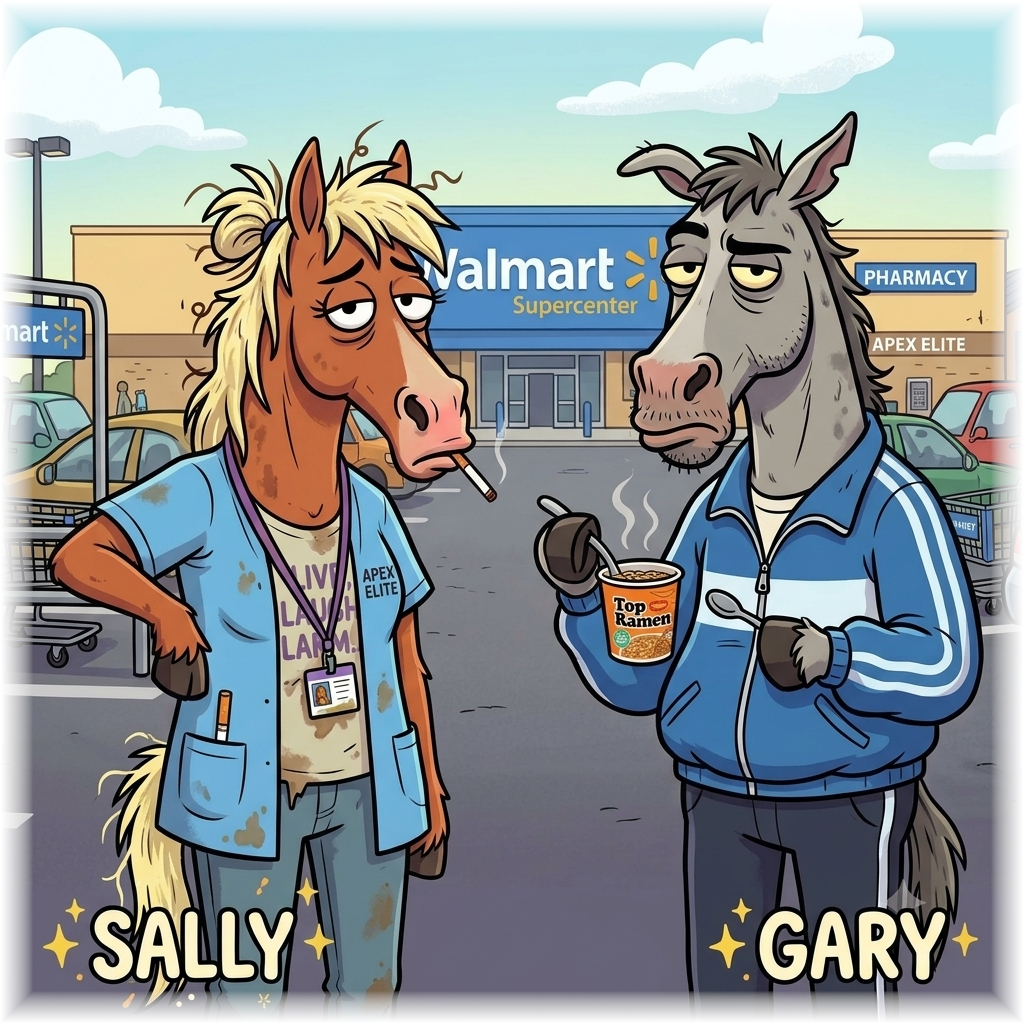
She was a dusty chestnut mare in a faded graphic tee that read LIVE, LAUGH, LAMINATE, a stained cosmetology-school lanyard around her neck, and a Maverick 100 riding her lower lip like it had grown there. Her mane was the exception to all of it: long, aggressively bleached, flat-ironed and teased and sprayed to a platinum blonde gone a little brassy at the ends, the way over-bleached blonde does — so over-processed it had the approximate texture of cotton candy left out in the rain. She was enormously, immovably proud of it. She put more hours into that mane than into the rent, the colts, or the written portion of the state board, and if you somehow failed to notice it, she would find a way to make you. When the boom mic drifted too near her ear she batted it away with a hoof — a bored little flick, the way you wave off a fly you don’t respect.
“You think we belong on a calendar,” she said. It wasn’t a question. “You think we’re out here galloping through the dew into some golden-hour sunset. Up there.” She tipped her head at the mountains without looking at them. “Bullshit.”
She took a slow drag and let the smoke go gray into the thin dry air. Most wild horses, she explained, got pregnant and dropped out of horse high school pretty early. Her, personally: fall semester of sophomore year. One minute you’re trying out for track and field, the next you’re crying behind the ag-mechanics shop because your hoof-gel didn’t dry right, and then — bam — you’re navigating open-range motherhood with zero credit history and two colts who came into the world hungry.
She leaned her shoulder blades against the metal bars of the cart corral and winced as a wave of lower-back pain rolled up her spine. Chronic, she’d tell you. A documented curvature. The kind of thing that happens to a body that’s carried foals and stood on concrete, and had nothing whatsoever to do with anything else.
“After a couple of foals, reality sets in,” she said. “The range doesn’t pay rent. So you enroll in cosmetology school. You trade the prairie for fluorescent lighting and split ends and a state-board written exam that makes zero sense when your primary appendage is a keratinous block.” She held up a hoof by way of evidence — flat, unlovely, a hoof — and let it drop. “And the worst part? My prescription didn’t even clear this morning. The Walmart pharmacy. Forty feet from where I’m standing.” She jabbed a hoof toward the sliding doors, where a blue-vested greeter waved at nobody in particular. “Flagged my profile for refilling three days early, like corporate America draws the line at a four-legged animal needing pharmaceutical-grade help to survive a twelve-hour shift of feathering synthetic bangs.”
She dropped the cigarette to the asphalt, ground it out under a worn hoof, and stared off toward the Garden Center like it owed her money.
Apex Elite Institute of Cosmetology shared a strip-mall wall with the Walmart, close enough that the whole operation smelled faintly of rotisserie chicken. Inside, under fluorescent tubes that buzzed like something trapped, rows of plastic mannequin heads sat bolted to sticky laminate tables. This was the state board — the first attempt, the one that would go badly. Sally stood at Station 4, breathing hard, a strand of synthetic blonde hair caught in her front teeth, her mannequin already looking like it had been fed through farm equipment.
Mrs. Henderson patrolled the aisle with a clipboard clutched to her chest and the permanent expression of a mare who has been let down by everyone she has ever met. She stopped at Station 4.
“Sally. We are forty-five minutes into the practical for chemical texture services, and your mannequin looks like it survived a threshing machine.”
“It’s an edgy, lived-in blowout,” Sally said, not looking up, a styling comb gripped in one hoof. “It’s called fashion. Look it up.”
“It’s a tangled hazard. And you’re drooling on the station.”
From Station 3, Chloe twirled a foil sheet in a hoof with the serene confidence of the young and subsidized. “Mrs. Henderson says my foil placement is pristine,” she announced to the room. “I’m going to work at a high-end salon. Right next to the TJ Maxx.”
“Shut up, Chloe,” Sally muttered, waving the comb for emphasis. “Your parents pay the lease on that 2018 Kia Soul and buy your organic alfalfa cubes. Some of us are supporting two ungrateful colts who think an empty bag of Cool Ranch Doritos counts as psychological enrichment.”
“Less inter-species bickering, more neutralizing,” Mrs. Henderson said. “The inspector is coming through the front doors any minute. If I see one more clump of loose mane on the linoleum, you’re all cleaning out the horse trailer this weekend.”
Sally’s ears flattened against her skull. A trailer. They wanted to put her back in a trailer. Irony, she thought, is a cold bitch, and she wears a polyester smock from Sally Beauty Supply.
The break room was a windowless closet with a stained microwave and a vending machine wearing a handwritten sign: DO NOT KICK IT, JUST CALL THE NUMBER. Gary was already at the sticky laminate table when she came in — a scruffy gray gelding in a tear-away tracksuit and a heavy five-o’clock shadow, scraping the foil lid off a cup of instant beef ramen with the edge of a hoof. Sally dragged her rear hooves across the linoleum, dropped into the folding chair across from him, and buried her muzzle in her forelegs.
“Rough session with Henderson?” Gary said. “You look like you cleared a five-bar fence and missed by six feet.”
“Chloe did a foil weave on a plastic head and told me my blowout looked like generational trauma.”
Gary slurped a noodle without moving anything else. “Kids today got no respect for the elders. Back when we ran wild — before they ran Highway 50 through and the subdivision fenced off the water —” He paused to tip the last of the broth out of the cup and into his muzzle. “— you didn’t critique a mare’s roller placement on a bad morning. You shared a patch of clover and minded your business.”
“Don’t start with the high-plains romance, Gary. The high plains didn’t pay my property tax or sit on a three-day prior-auth hold at the pharmacy.”
“You still fighting them over the oxycodone?”
“The pharmacist looked at me like I was the criminal. Like a thirty-four-year-old mare with a documented curvature of the spine — from carrying two foals and standing on concrete twelve hours a day — is out here trying to scam Big Pharma for a fun little afternoon. It’s medical.”
“Sure,” Gary said. “Swayback.”
“Chronic. Lumbar. Subluxation.”
“That’s what I said.”
The door opened. It kept opening. Filling the entire frame was Marcus — a black stallion the size of a vending machine, shoulders like a defensive line, a coat so dark it seemed to drink the fluorescent light. Gary froze mid-noodle. For one full second the whole room braced.
Then Marcus’s face crumpled with tender concern, and when he spoke his voice was soft as a lullaby. “Sally. Oh, honey. I heard about Station Four.” He crossed the room in two strides that rattled the microwave, folded himself into a squat beside her chair — gentle as a man setting down an egg — and took her hoof in both of his. “Look at me. A mannequin is not a mirror. What Chloe said was violent, and I told her so, and then I fixed her foils, because between us they were a catastrophe.”
“I’m fine, Marcus.”
“You are not fine, and that’s allowed. When I washed out of Grand Prix — Rotterdam, center ring, forty thousand people, one bad distance at the final oxer — I didn’t eat solid food for a week. And now look at me. Best brow lamination in three counties and a color-coded planner.” He reached into his apron and produced a tiny, immaculate spoolie brush, offering it to her like a rose. “Your arches have been screaming since March. Let me. It’s free. It’s love.”
“He did mine for my birthday,” Gary said quietly, to no one. “He remembered my birthday.”
“June ninth, Gary,” Marcus said, not turning. “I remember everyone’s.”
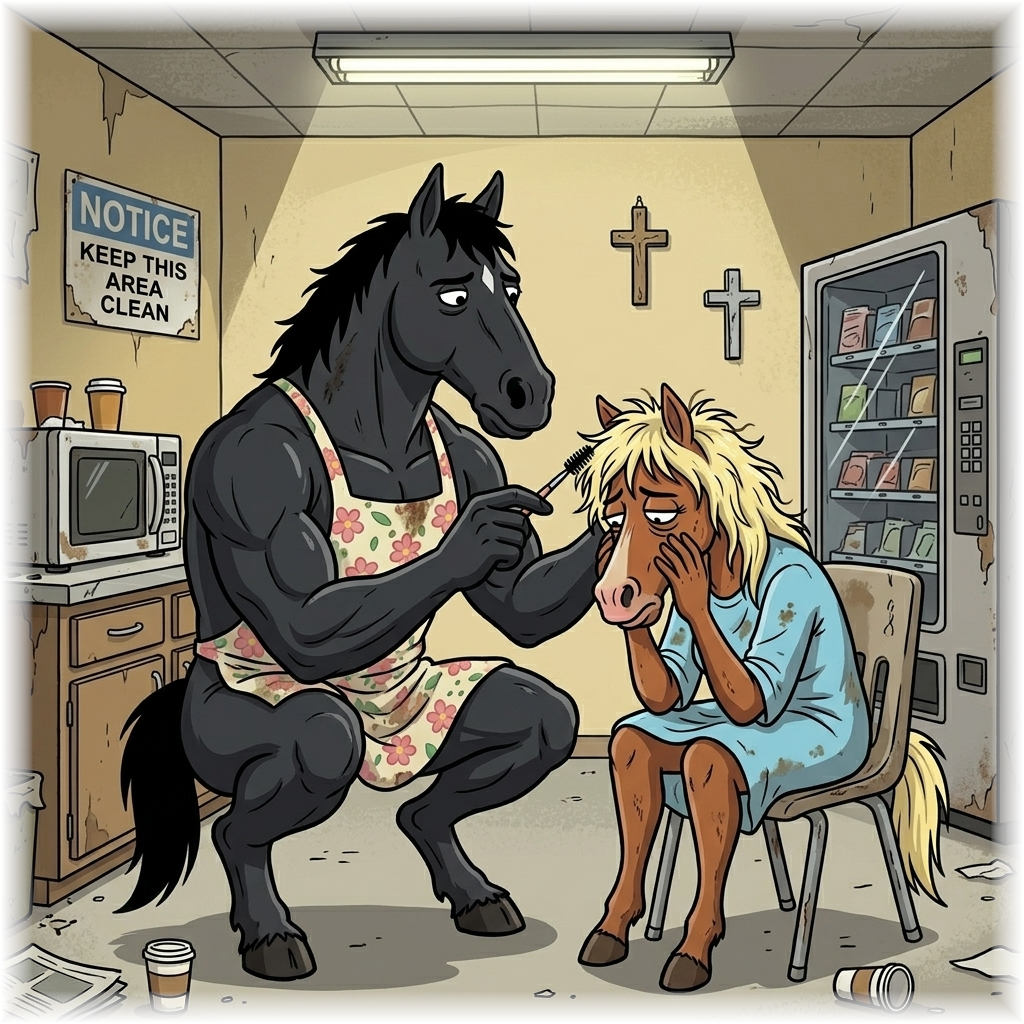
Sally let him tilt her chin up with the flat of a hoof, and for a second — just a second — she let herself be taken care of. Her eyes went glassy. Then a whole warm wave of feeling rose up in her, and because she was constitutionally incapable of receiving kindness, she stood too fast and knocked the chair.
“You know what, I gotta — my back,” she said, too bright, backing toward the door. “I need air. For my back.”
“The retake is Thursday,” Marcus called after her, welling up himself. “Go see Héctor! He believes in you and his elote has electrolytes!”
But she was already gone, banging out through the glass doors into the gray afternoon, patting her smock for the cigarettes. Marcus watched her go, pressed the little spoolie to his chest, and sniffled. Gary slid him a napkin without being asked.
The problem with kindness, Sally thought, is that it doesn’t clear at the pharmacy either.
In the far corner of the same parking lot, past the cart corral, a spotless white food truck idled under a hand-lettered awning: EL REBUZNO — TACOS · ELOTE · MOBILE DETAILING. A smaller sign in the same tidy paint read ASK ABOUT THE PUNCH CARD. There was a line — tourists coming down off the Royal Gorge, a couple of corrections officers still in their browns on the front end of a shift change, a handful of horses — and it waited, orderly and patient, in the drizzle. Business was good. Business was always good.
Héctor ran the truck. He was a compact gray donkey in a pressed apron and a paper cap, and in a town of horses that made him another species, one the mares were quietly certain they were better than. Héctor did not appear to have received this information. He worked the flat-top with both hooves — one flipping, one plating — never rushing, never missing a ticket, an accordion playing tinny out of a little radio behind him and a pegboard of detailing supplies sorted by size. He was, without contest, the calmest object for a hundred miles.
Sally walked straight to the front and cut the entire line. Nobody stopped her. Everybody noticed.
“Héctor. Emergency. I need an elote, extra cotija, and I need you to spot me till Friday.”
“Friday of which week, Sally,” he said, not looking up, sliding a finished plate into the window.
“I bombed the practical. Henderson says my mannequin looks like it went through a threshing machine. Chloe told me my blowout looked like generational trauma. I am one prior authorization away from living in that trailer again.”
“You told me last Tuesday you’d study,” Héctor said evenly, starting her corn.
“You went to the parking lot instead.”
“I was managing my back.”
“You were managing your back in the pharmacy line for forty minutes. I saw you from the truck.”
A sleek young mare in the line, AirPods in, a Stanley cup sweating in her grip, leaned to her friend and did not quite lower her voice. “I mean — would you get a taco from a donkey? Like, hygienically?”
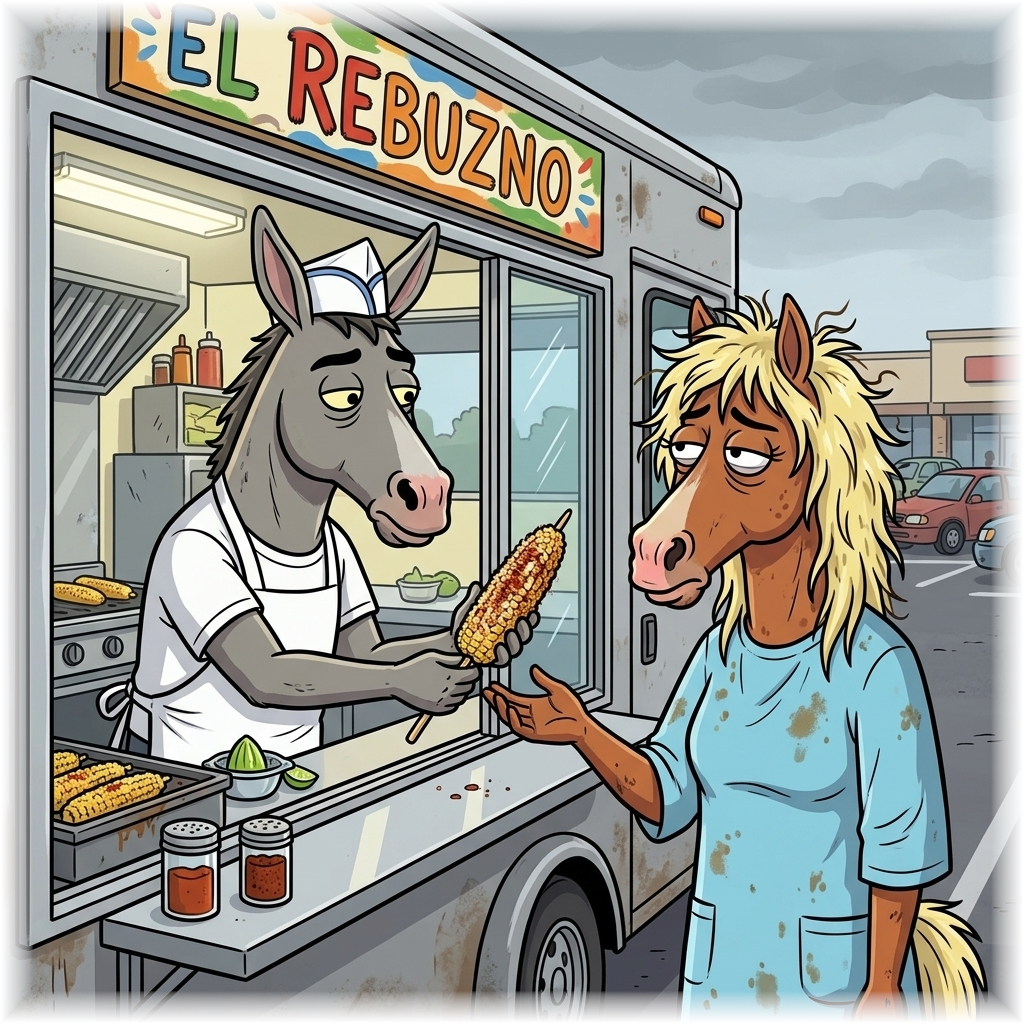
Héctor didn’t react. He didn’t have to. He turned the finished elote to the light, checked it, handed it across to Sally — perfect — and rang the next ticket without a beat. The line had not moved for anyone but him. Ninety seconds later the mare with the Stanley cup ordered two tacos and thanked him twice.
“See, this is what I mean,” Sally said around a mouthful of corn, gesturing with the elote in a hoof. “You’ve got the truck, the punch card, the little pegboard. You detail a Kia in the morning and sell out by two. Meanwhile I’ve got a keratinous block for a hand and a state board that hates me.”
“We’ve got the same hands, Sally.” He held up one hoof — flat, unremarkable — then went right back to plating three orders with it while she watched. “I just showed up.”
She chewed on that, and on the corn. Without being asked, Héctor slid a paper cup of water across the counter — the exact thing she needed. He still hadn’t spotted her the money. He wasn’t going to.
“Retake’s Thursday,” he said. “Come by at six, before I open. I’ll be your mannequin.”
“You’d let me run a chemical texture service on your actual mane.”
“I’d let you practice studying. The mane’s a maybe.”
He turned to the window and called the next number. Sally lingered a second longer than she meant to, holding a perfect elote she hadn’t paid for, in a hoof, outside a Walmart, watching the one guy she looked down on run circles around her whole species.
The rent was still the rent, and the pharmacy had eaten whatever the rent hadn’t, so that evening Sally did the thing she swore every single time she would never do again. She drove up to see her mother.
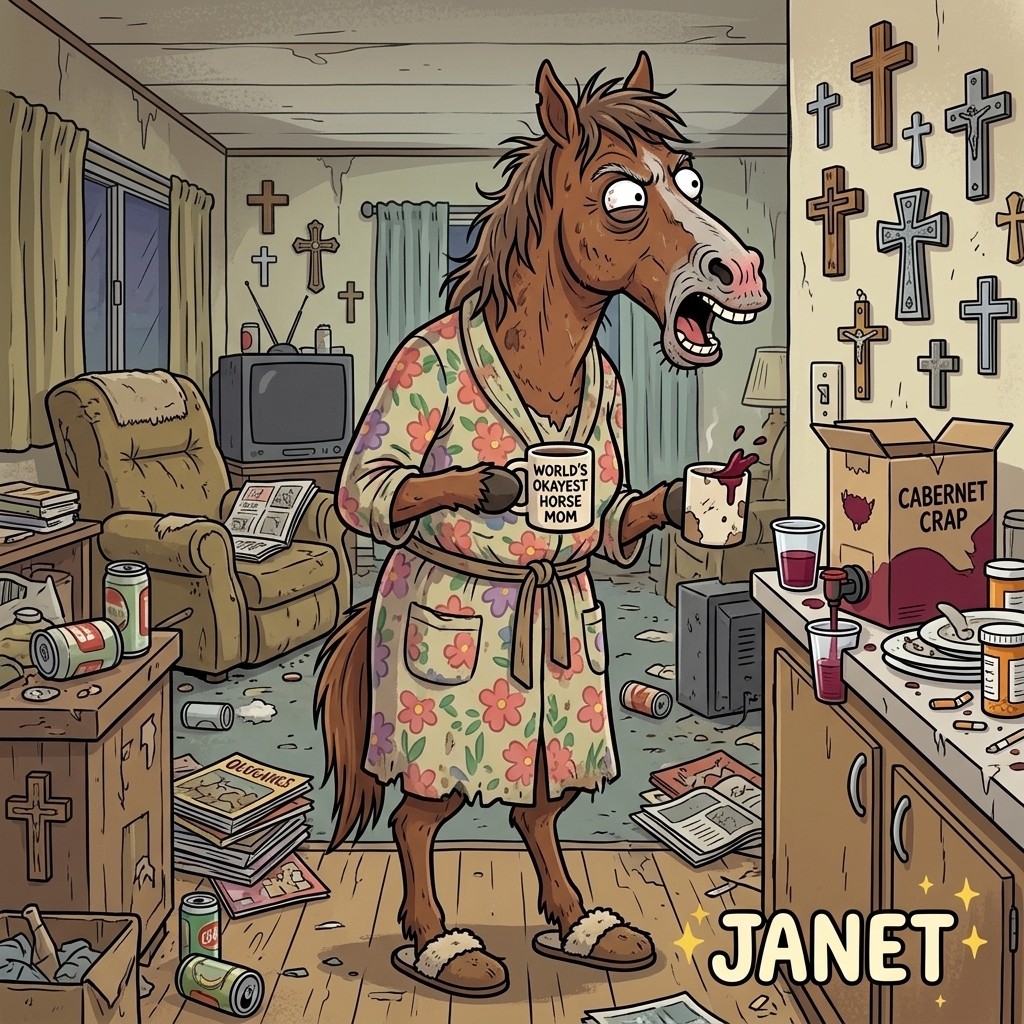
Copper Gulch Road climbs southwest out of Cañon City and turns to washboard dirt inside a mile, switchbacking up through juniper and busted red rock past homesteads that cling to the hillsides like ticks. Janet lived at the end of the maintained part and a little past it, in a doublewide gone the exact color of the dirt around it, ringed by dead cars, a leaning propane tank, a satellite dish aimed hopefully at Heaven, and a fence she had built herself entirely out of crosses — some lashed together from fence pickets, one that had plainly started life as a coat rack.
Her mother met her at the door holding a coffee mug that did not, from ten feet away, smell like coffee. Janet was a rangy old bay mare with a wandering eye, a floral housecoat, and the high color of a woman who has been arguing all afternoon. At the moment she was arguing with the corner of the porch.
“Not now, Bartholomew,” she said to the corner. Then, turning to her daughter, warm as anything: “The demon by the water heater. He’s been at me since Epiphany. Come in, baby. Mind the salt.”
There was, in fact, a line of salt across the threshold. Sally stepped over it.
Inside, a televangelist roared from a television bolted up near the ceiling, and the whole place smelled of boxed merlot and scented candles fighting to a draw. Janet crossed to the refrigerator, worked the little spigot on a bag of Franzia into her mug, made the sign of the cross over it, and took a long, medicinal pull.
“I need to borrow rent, Mom. Just till the board comes through. I passed — I’m going to pass. There’s a retake Thursday and then it’s real money.”
“Money.” Janet said the word like it tasted of sulfur. She dropped her voice and cut her eyes to a spot just left of Sally’s head. “They come in through money, you know. The little ones. That’s their door.” She flapped a hoof at the air by the ceiling fan, shooing something only she could see, and then, without changing register at all: “There’s forty dollars in the King James on the mantel. Don’t take the bookmark, it’s blessed.”
Sally found the Bible. There was no forty dollars in it. There was a religious tract folded to look like a bill, and a coupon for a car wash that had closed in 2011.
Janet peered at her daughter then — really looked, the wandering eye almost settling — and her face softened into something halfway to lucid, which was worse. “Your eyes are pinned, Sally-girl,” she said quietly. “I know that look. I raised that look.” She reached out and patted Sally’s cheek with a trembling hoof.
“There’s a spirit on you. The same one that rode your father into the ground. You let me pray it off.”
“I don’t need it prayed off, Mom. I’ve got chronic lumbar —”
“Subluxation,” Janet finished, nodding along, gentle as anything, the way you agree with a child. “Course you do, baby.”
For one terrible second the two of them stood in the merlot-and-candle dark, two mares and one shared thing wearing two different costumes, each one certain she could see it plain as day on the other. Then Bartholomew apparently did something behind the water heater, because Janet whirled and hollered at the wall, and the moment broke, and it was time for Sally to go.
She left with the tract, the dead car-wash coupon, and a plastic rosary her mother pressed into her hoof at the door, “for the drive.” Backing down the washboard road in the last of the light — the mountains going black behind her, the prison town glittering small and mean in the valley below — Sally hung the rosary on the rearview, lit a Maverick off the dashboard lighter, and did not once consider that she had just watched her own future stand in a doublewide and argue with a water heater. She had a rent problem. That was the whole of the list. Everyone in her family had a demon except her.
She lived above a vape shop in a cramped second-floor unit decorated in Employee-of-the-Month plaques she had awarded herself and a wall clock shaped like a rooster. Wednesday night, or by then Thursday morning — 3:11, the rooster said — an infomercial played to no one, and from the master bedroom came the specific, total silence of a mare who is very, very comfortable.
The living room floor was a nest of sleeping bags. Tanner, her younger colt, twelve, and two friends — Brayden and a smaller colt in a fire-truck onesie — were supposed to be asleep. They were not. They were watching Cody.
Cody, her oldest, seventeen, had not slept since Monday. He was a rail-thin colt vibrating at a frequency just below sound, ringed by the disassembled guts of the family toaster, a PlayStation, and a box fan, a soldering iron glowing in one hoof. His jaw worked on nothing. His eyes were two full moons.
“The thing about the toaster nobody tells you,” he was saying, rapid and delighted, “is it’s basically a router. It’s a router, Tanner. I’m gonna mesh the whole apartment. I’m gonna mesh the whole complex. I already talked to a guy.”
“It’s four in the morning, Cody,” Tanner said, flat, twelve going on fifty.
“Time’s a router too, bro.”
Brayden had drifted to the bedroom door. “Is your mom okay? She’s kind of — gray.”
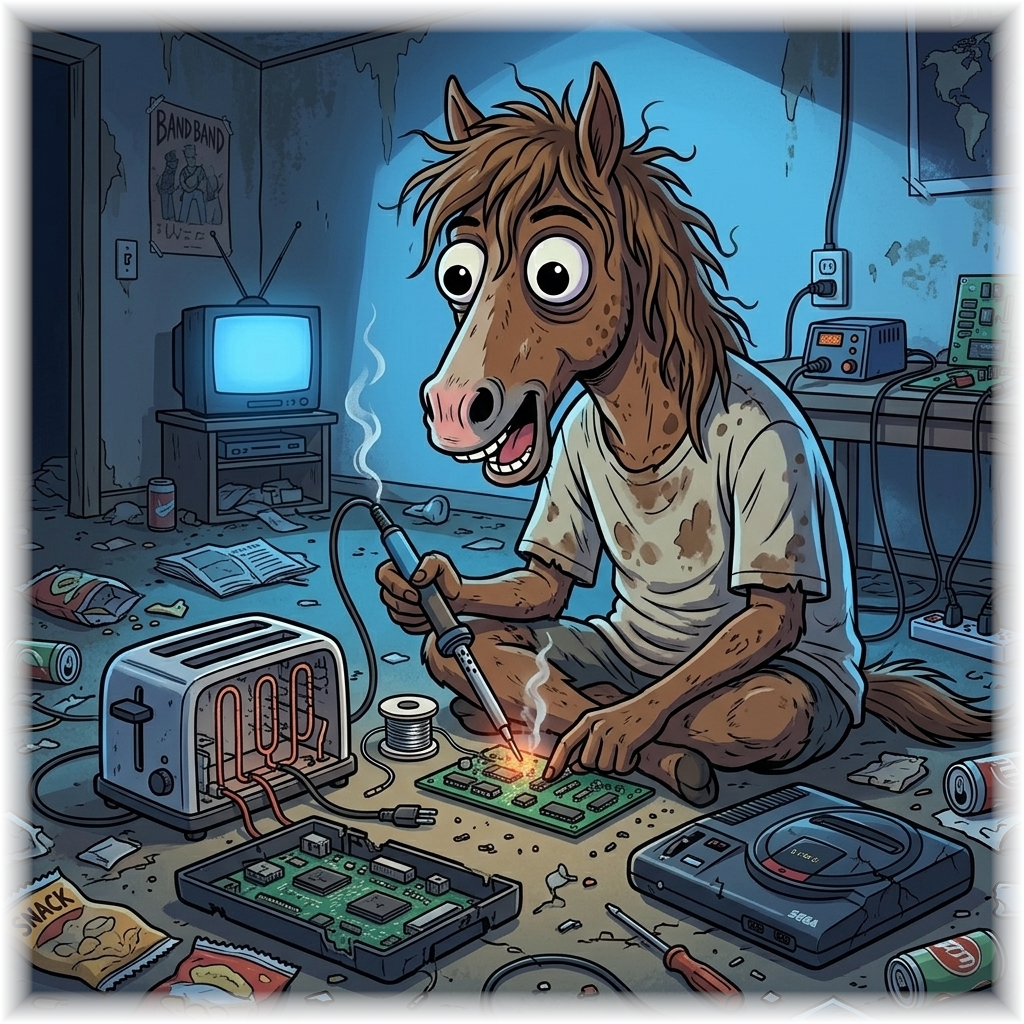
“She’s fine,” Cody said, not looking up. “She’s just having her evening.”
Tanner joined him at the door. Sally lay sprawled crosswise on the bed in her Sally Beauty smock, one hoof trailing the carpet, a forgotten Maverick gone to a worm of ash in the tray beside her. She was smiling at the ceiling. She was somewhere warm.
“Should we, like, do something?” Brayden whispered.
Cody’s head turned. Slowly. And behind his enormous pupils a terrible, wonderful idea arrived. He set down the soldering iron. From the nightstand — between a Bible and a half-eaten Lunchable — he lifted a slim white box like a relic. Narcan. There were six of them, still shrink-wrapped in a bulk-club brick. In this house it restocked like paper towels.
“Tanner,” he said, reverent. “Get your phone.”
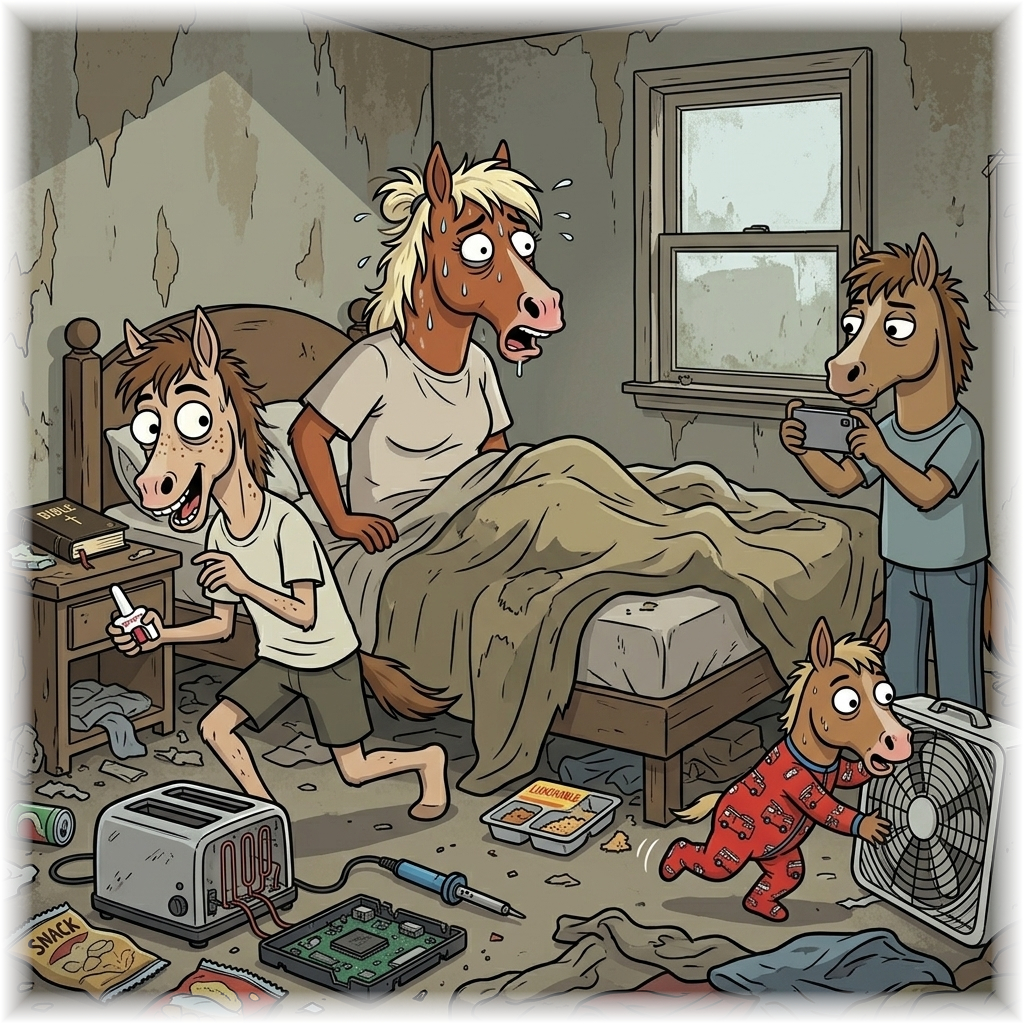
He crept in, colt-shadow long across the carpet, the little ones stacking up giggling in the doorway behind him. He leaned over his sleeping mother with the awful tenderness of a boy who had done this before, for real, back when it wasn’t funny. He fit the sprayer to her nostril. A beat. He pressed.
Sally’s eyes snapped open like a haunted-house prop. The warm ceiling was gone. The world was suddenly very bright, very loud, and her spine was a downed power line.
“No,” she said, instantly, horribly awake. “No-no-no — who — Cody —”
She lurched upright, sweating straight through the smock, torn out of her evening and dropped into fluorescent hell, and the colts scattered shrieking, sleeping bags flapping, the fire-truck onesie eating it over the box fan. Cody backpedaled into the hall, filming, cackling, incandescent.
“She’s up — she’s up, oh my god, she did the leg thing —”
“That is a medical device, Cody!” She swung her hooves to the floor, murderous and dopesick. “That is for emergencies!”
“This is an emergency! I’m bored!”
“You want to talk devices — when did you last sleep? You’ve been up since the Fourth of July! You took apart the Xbox!”
“I optimized the Xbox!”
“You’re grinding your teeth down to the gumline —”
“And you nod off into your own soup! At least I’m awake, Ma. At least I’m productive —”
“One of us awake at all times is not a family, Cody. It’s a neighborhood watch.”
They stood there in the hallway light, seventeen and thirty-four, wired and dopesick, the same disease pointed in opposite directions, each of them certain the other one had the problem. Neither of them would ever say it. The rooster clock ticked. Somewhere the fire-truck onesie was crying a little.
By the time the fight burned down to fumes it was nearly four. Sally, wrung out and swaying, retreated into the warm dark of the master bedroom and pulled the door shut behind her. Tanner had already posted the leg thing — it was up before the box fan stopped spinning, and by breakfast it would have more views than Sally had dollars.
But Cody didn’t sleep. Cody never slept. Alone now in the wreckage of the living room, the sprayer still on the carpet where he’d dropped it, the adrenaline of the prank curdled in him into something far worse. He had done this before, for real, back when it wasn’t funny — knelt over her exactly like that and pressed and begged and counted — and the memory came back all at once and would not leave. His jaw worked on nothing. His chest hurt. And a tweaker cannot sit still inside a feeling; a tweaker has to build his way out of one.
The idea arrived the way all his ideas arrived: complete, enormous, and hand-delivered by God. He would fix it. Not the mug, not the morning — all of it. He would go back to before the sprayer, before the smock, before the pharmacy and the swayback and the trailer, and he would take the whole thing back for her. He just needed a machine. And he already talked to a guy.
He did the last of what he had — a bump to think, another to build — and went looking for a chassis big enough. Down the outside stairs, past the dark vape shop, to the car.
By dawn the little lot behind the vape shop looked like a yard sale hit by lightning. Sally came down into the pink-gray light with the WORLD’S OKAYEST MOM mug in one hoof and her keys in the other, and stopped dead.
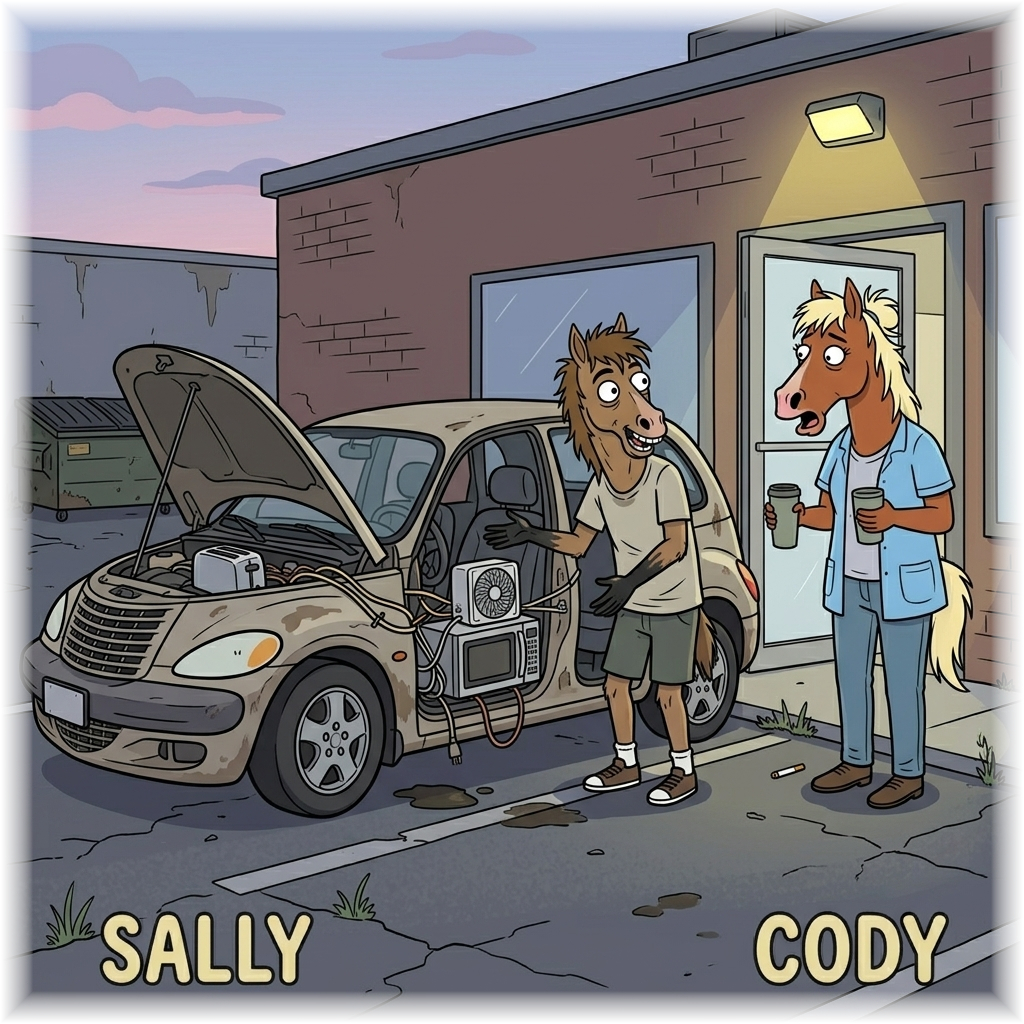
The Cruiser — her ’04 PT Cruiser, the one machine in her life that still technically ran — sat with its hood up, its doors off, and its dash peeled open to the wires. The toaster was in it. The box fan was in it. The PlayStation, the microwave, the guts of the rooster clock, and what was unmistakably the compressor off the refrigerator had all been wired into the steering column with lamp cord and zip ties and hope. Cody stood in the middle of it, black with grease to the elbows, teeth going, radiant.
“Ma. Ma, don’t be mad, okay, don’t — this is for you —”
“What did you —” Her voice came out very small. “Cody. That’s the car.”
“It’s not a car anymore, that’s the whole point, I optimized —”
“That is the car, Cody! That’s how I get to the — oh my god, is that the fridge? Where is the fridge?”
“I needed the compressor!”
There was no arguing with it. There was never any arguing with it. She stood in the wreckage of the only appliance that let her leave the county, on the one morning she could not afford to be stranded, with no car, no fridge, and a son beaming at her out of a chrysalis of stripped copper — and she did the only thing left to do. She took out her phone and called the one soul in that town who would already be awake, dressed, planner open, and idling at some curb within four minutes.
Marcus’s sedan was spotless and smelled of vanilla. There was a little dish of butterscotch candies in the console and a travel pack of tissues in the door. He said not one word about the mug, the mane, or the smoking Cruiser in the mirror. He handed her a tissue she hadn’t asked for, cued something soft and instrumental, and pulled out like he was ferrying the last chopper off a rooftop.
“He built you a time machine,” Marcus offered gently, after a mile, eyes on the road. “Sally. In its way — that’s love.”
“He built me a walk to work is what he built me.”
Marcus’s chin began to tremble. He signaled a full block early. “I think it’s beautiful,” he whispered, and cried a little, and drove her across town to the lot.
The lot was empty at that hour, the light the pink-gray of a day that hadn’t decided anything yet, the mountains just starting to come up out of the dark in the west. El Rebuzno sat dark and closed, but the service window was up, and Héctor had already set out a folding chair, a clean towel, a caddy of combs and clips squared to the edge of the counter, and a thermos. He took one look at her — smock rumpled, mane a wreck, sunglasses on against a sun that wasn’t up — and said nothing about it. He poured from the thermos and slid the cup across.
“Electrolytes. Drink the whole thing.”
“Rough night,” she said, easing into the chair.
“I know. Tanner posted it.”
She put her face in her hooves. Héctor let her have the second, then pulled the folding chair around and sat down in it himself, facing away, offering her the back of his own head — his actual black mane, thick and show-quality even now.
“Chemical texture service,” he said. “Twenty-two minutes. Board conditions. Go.”
“I can’t do it on a real — Héctor, I’ll ruin it.”
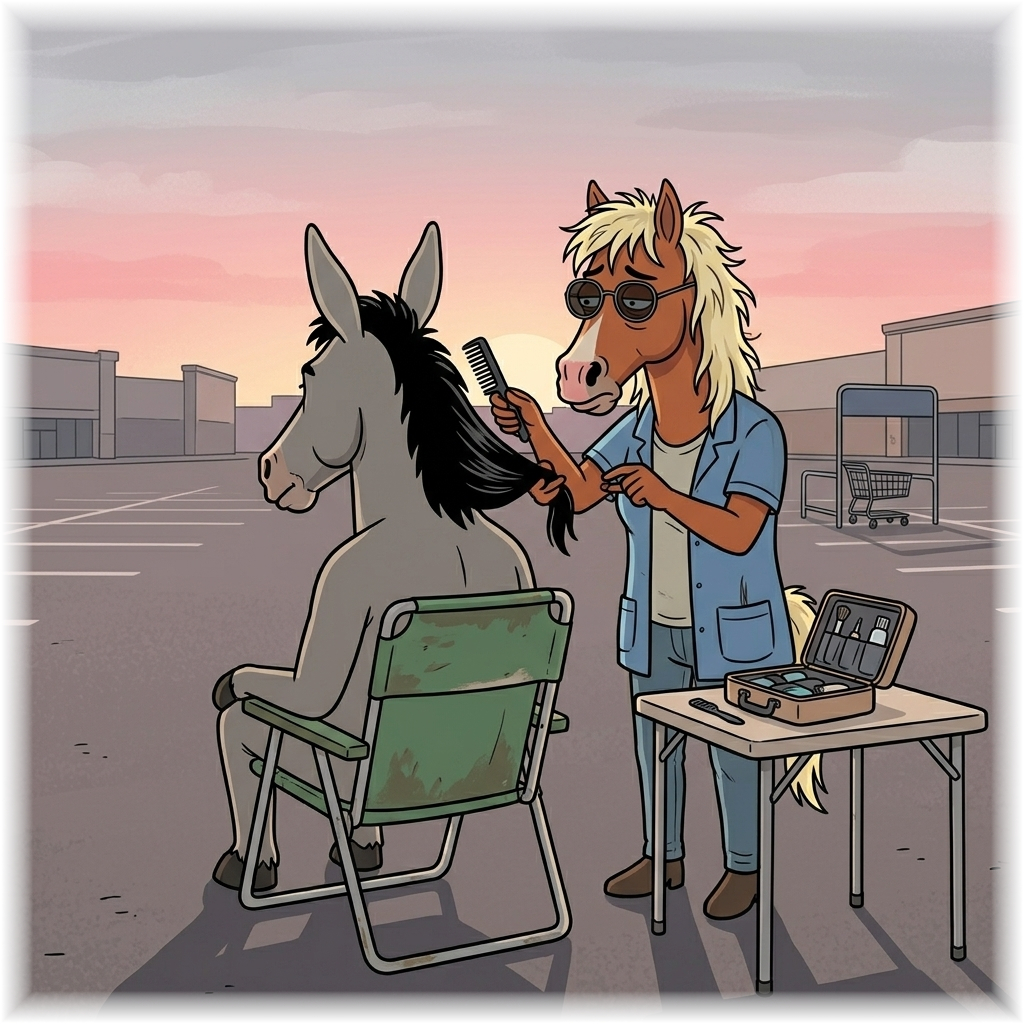
“You practice on the plastic head because you’re scared to touch the real one. The board can tell. Sections, Sally. Start at the nape.”
A long beat. Then she set the cup down, snapped a glove over a hoof, lifted a comb — steady in the hoof for the first time all night — and began to section his mane at the nape. Her shaking stopped the moment the work started. Dopesick, un-numbed, feeling every raw inch of the morning, she was, for once, completely there. And her hands were good. They had always been good.
Héctor watched her in the dark reflection of the service window. He didn’t smile. “There it is,” he said quietly, facing forward.
“Shut up. I’m neutralizing.”
She worked, and the sun cleared the Garden Center roofline and the peaks behind it and landed on the two of them — a donkey letting a horse practice on his good mane at dawn, a horse doing the one thing she had never once been high enough to fake. The lot began, slowly, to fill.
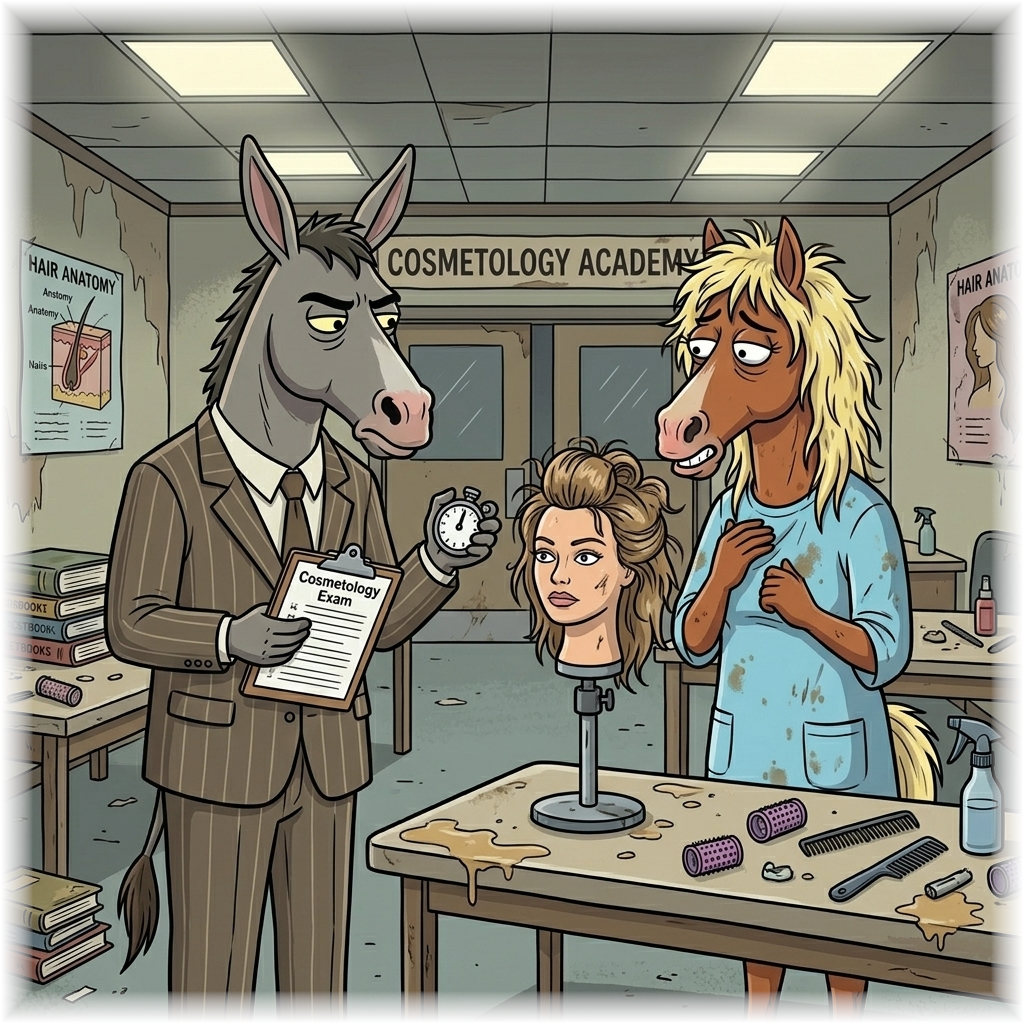
She tested better dopesick, it turned out. Not the kind of thing you put on a brochure.
By mid-morning Apex Elite had been scrubbed to a nervous shine. Someone had clip-lit the stations to supplement the buzzing tubes, and the mannequin heads sat at attention down the laminate like a seated jury. By the door, a folding table held a sign-in sheet, a bowl of individually wrapped mints no one would touch, and Examiner Pruitt — an out-of-county mule with a stopwatch, a laminated rubric, and the warmth of a parking meter. A mule: half of each and beholden to neither, which is exactly the animal you want enforcing rules.
At Station 3, Chloe had arranged her kit like a surgeon’s tray — every bottle labeled, every clip color-sorted, a good-luck charm from home clipped to her smock. At Station 4, Sally was sweating out the dawn, sunglasses shoved up into her platinum mane — which even she had to concede was having its worst morning in years, and that was saying something for a mare who treated that mane like the last load-bearing wall in the house — her hooves not quite steady over a fresh mannequin head. And in her smock pocket: the bottle. It had finally cleared that morning — the prior auth, the three-day hold, all of it — and now it sat against her ribs, full, rattling once when she breathed. One would iron the shakes right out. She knew exactly what one would do.
Mrs. Henderson came down the row, clipboard to her chest, and stopped a half-second longer at Station 4 than anywhere else. “Nape to crown,” she said, low, not quite kind and not quite not. “Clean sections. And so help me, Sally, if that head comes out looking like a threshing machine got it, I will hitch the trailer myself.” A beat. “You’ve got good hooves. You’ve always had good hooves. That was never the part that scared me.” And she moved on before Sally could answer.
Across the floor, past the glass of the interior door, an enormous familiar shadow pressed close — Marcus, not allowed in, mouthing something urgent and pointing at the back of his own head. Sally read his lips: nape, sections, breathe. Then he gave a double thumbs-up with both hooves and immediately, visibly, began to cry.
“Candidates,” said Examiner Pruitt, flat, without looking up. “Chemical texture service. Board conditions. Twenty-two minutes. Your time begins — now.” The stopwatch clicked. It was the loudest sound in the room.
Sally’s hoof drifted to her pocket. The bottle. The shakes. Twenty-two minutes of feeling every raw nerve she owned — or one little pill and the smooth grateful dark. Her hoof closed around it.
And then she thought about a donkey’s good black mane at dawn, and steady hooves, and being, for once, all the way here. She took the bottle out. She set it, capped and face-down, on the station next to the mannequin, out of reach. A paperweight. A dare she would never in a hundred years have called that. And she started at the nape.
Her hooves stopped shaking the instant the work began. She sectioned clean and even, the comb sure in one hoof, the rods going in tight and square, and she did the best work of her life while being furious about how much it hurt. Two stations over, the wheels came off Chloe — under a real stopwatch and a real examiner and a rubric her parents could not call about, her pristine hands had turned to stone. She was over-processing. She was crying without sound.
“I don’t — where do you even —” Chloe whispered, to no one.
“Nape, Chloe,” Sally said, not looking up, not slowing down. “Start at the nape.”
Chloe stared at her — the mare she had called generational trauma — then swallowed, and started at the nape.
Examiner Pruitt worked the row with her laminated card, saying nothing, checking boxes with the joy of a mule who had never once been surprised by anything. She reached Station 4. She circled the mannequin. She lifted a curl with the tip of her pen. She checked a box, and another box, and she did not smile, because mules do not smile, but she paused one extra beat over the nape line.
“Station Four,” she said to the room, already moving on. “Pass.”
That was it. That was all it was. No music — just a mule with a clipboard three feet away and getting farther. But across the floor Mrs. Henderson closed her eyes for exactly one second, and at the glass Marcus made a sound no one could hear and hugged the door frame.
Sally stood over her one good mannequin head, breathing hard, shaking again now that the work was done, the capped bottle still face-down where she’d left it. She had won. She had actually won. She looked at the little brown bottle like it was an old friend who had driven all the way out here just for her.
“Okay,” she said, quiet, picking it up, turning it in a hoof. “Okay, yeah. We earned that one.” And she thumbed the cap.
Denial, it turned out, was the one texture service she would never fail.
Behind her, Chloe’s timer ran out, and somewhere Mrs. Henderson was already saying her name for the next thing, and out past the strip-mall wall the plains ran east into the haze and the mountains stood up white in the west, indifferent to all of it, the way they had been the whole time.
They give you a license for the hair, Sally thought. Nobody’s ever once tested me on the rest of it.
Cody finished the machine a little after two the following morning.
He hadn’t slept — the arithmetic on that had quit meaning anything back around Tuesday — and he’d had to rebuild the whole thing twice since his mother took the first version apart with a push broom and some language. But at 2:14 a.m., behind the vape shop, the Cruiser lit up from the inside like a slot machine paying out, the compressor screamed, the rooster clock’s second hand crawled backward, and the air over the driver’s seat folded in on itself with a sound like the world clearing its throat.
It worked. It actually, impossibly worked.
And for one clean second Cody remembered why he’d built it. He was going to go back. He was going to take back the sprayer and the smock and the pharmacy and the trailer, all of it, and hand his mother one morning that didn’t have any of that in it. He’d promised himself. It was the one good thing he had ever set out to do.
Then the second ended, the way seconds do, and the craving came in behind it, patient and enormous, and it had a much better idea.
He set the dial back four hours, to just before he’d run out, stepped through, and there he was — the earlier Cody, mid-build, grease to the elbows, grinding his teeth down to the roots. He reached past that kid without a word, lifted the fat little bag out of his own hoodie pocket, stepped back through, and left the guy to wonder. A perpetual-motion machine — the very one the family had been trying to build for three generations — finally up and humming: an endless supply of high, stolen forever off a version of yourself who would only miss it later.
He should have stopped there. He was, for the first time in anyone’s memory, holding the whole steering wheel of time in two hooves, and there was nowhere on it he wanted to be less than exactly here.
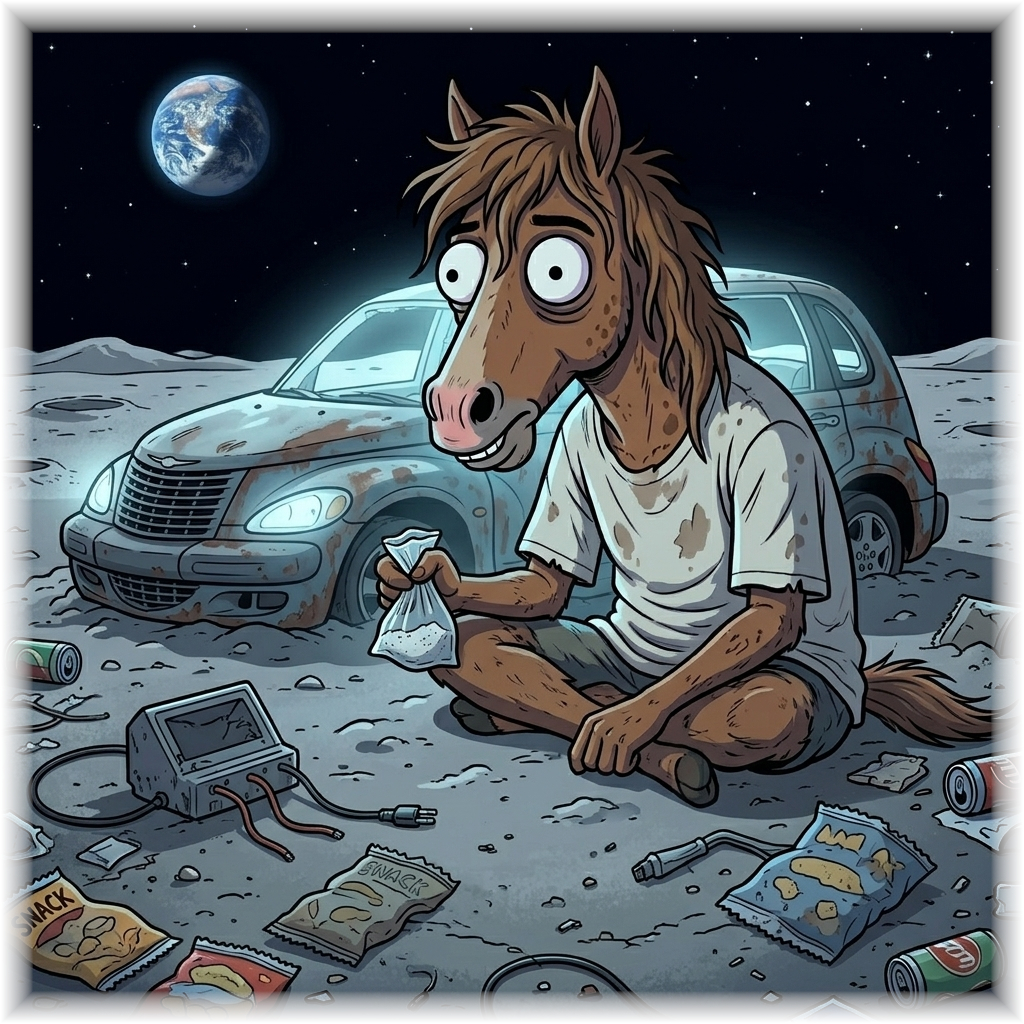
So he spun the dial as far as it would go — past the numbers he knew, past the numbers anybody knew — and let it fall on the year 10,000, because it was round, and it was far, and it was away. And he punched it.
The lot went first. Then the town. Then the mountains stood up white in the west one last time and were gone, and so was the air.
Eight thousand years downstream, on the gray dead curve of the moon, with the whole blue marble of the Earth hanging small and quiet overhead the way it hangs over everybody, a seventeen-year-old colt sat down in the dust, took the bag out of his pocket, and got high — as far from Cañon City as a body can physically travel, and not one inch further from the thing he’d carried all that way in his own chest.
He’d taken himself with him. That was the one part nobody ever optimizes out.
They never tested him on that either.